Real-time payments have moved from novelty to core infrastructure.
ACI Worldwide's 2024 Prime Time for Real-Time report counted 266.2 billion instant transactions globally in 2023, up 42.2% year on year, with a forecast of 575.1 billion by 2028. Two years on, the pace suggests the market is at least on track: India’s UPI alone processed more than 228 billion transactions in 2025, up from 117.6 billion in 2023.
Every major instant scheme was built as domestic infrastructure, and that was the design intent. Brazil's Pix, India's UPI, the UK's Faster Payments, Thailand's PromptPay, Colombia's Bre-B, and the US duo of RTP (run by The Clearing House) and FedNow all solve the same problem inside national borders.
Brazil shows how deep that can go: 76.4% of Brazilians surveyed by the Banco Central do Brasil in mid-2024 said they use Pix, more than debit cards (69.1%) or cash (68.9%). Cash has retreated alongside it: the share of Brazilians who use cash as their primary payment method fell from 42% in 2021 to 22% in 2024.
The interesting question in 2026 is what comes next.
Domestic rails are starting to connect to each other through multilateral hubs like Project Nexus, through bilateral links such as the Banco Central do Brasil's September 2026 feasibility study with the ECB on linking Pix to TIPS, and through new rails coming online across Latin America. Stablecoins are moving into the same cross-border territory from a different direction.
The rest of this article covers how real-time payments work, where they stand today, and how the convergence is taking shape.
What are real-time payments?
Real-time payments move money directly between two bank accounts in seconds, around the clock, with settlement that is final by default. The transfer runs account-to-account (A2A), skipping the card networks and the batch cycles of legacy ACH.
Most modern schemes carry the payment on the ISO 20022 messaging standard, which gives each transaction enough structured data to reconcile automatically.
There are three design choices that make the model work:
 A2A routing. Funds move bank to bank, with no card network or interchange in the middle.
- 24/7 availability. The rail runs continuously, including weekends and public holidays, rather than clearing in business-hour batches.
- Final settlement. The transfer is irrevocable once it clears. Some schemes layer a dispute process on top (Pix added the MED fraud-refund mechanism in 2021), but the underlying transfer is not reversible like a card chargeback.
That combination is why real-time payments are now the cheapest and fastest way to move money inside most of the markets that have rolled it out.
How the rails actually compare
Three families of rails carry most of the world's payments. They differ less in raw speed now and more in routing, cost, and reach.
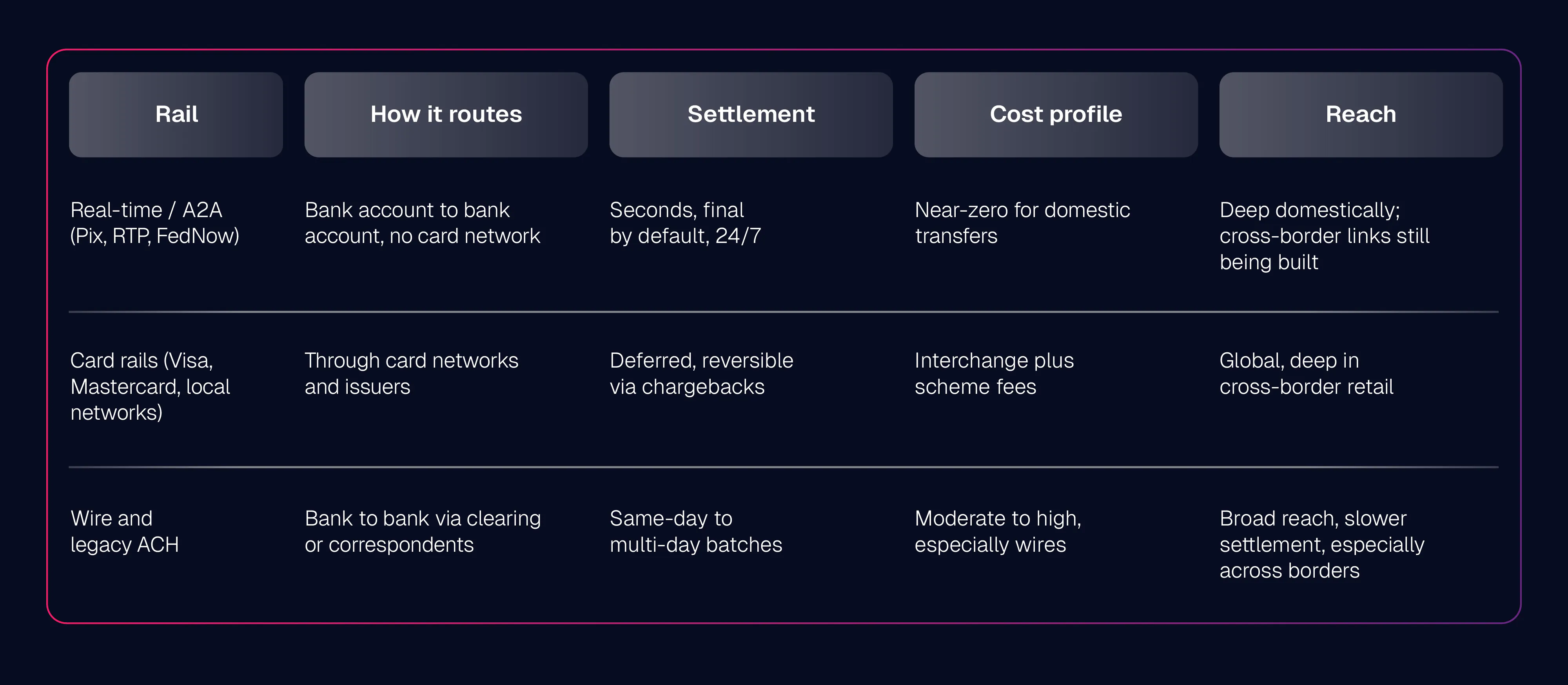
The economics change with it: no interchange, instant liquidity, and a data trail rich enough to reconcile automatically when it runs on the ISO 20022 messaging standard. Card payment rails still own credit and cross-border retail, but for domestic transfers, A2A is now the faster and cheaper path.
Two regions built the same rail differently
Latin America built instant payments as public infrastructure. The United States left it to the market. The split explains why adoption looks so different between them.
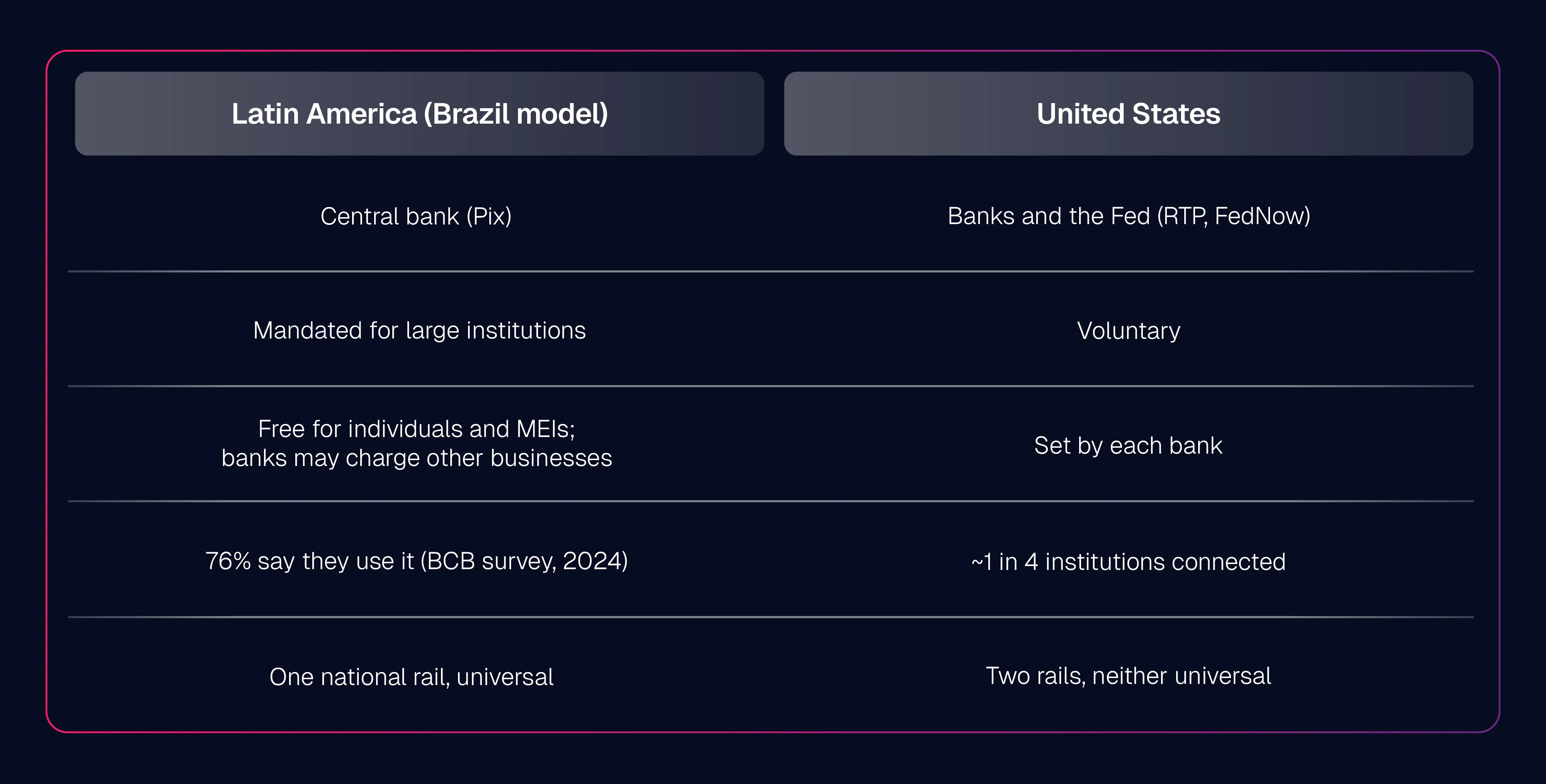
Banco Central do Brasil required authorized financial and payment institutions with more than 500,000 active accounts to join Pix (Resolução BCB nº 1/2020); since September 2026 (Resolução BCB nº 587) it can grant case-by-case exemptions.
Adoption compounded. By 2025, person-to-business payments had nearly caught up with person-to-person transfers, at 43% versus 44% of all Pix transactions, up from 6% in 2020 (Banco Central do Brasil, Relatório de Gestão do Pix 2023–2025). Which means Pix stopped being a way to split dinner and became a way to run a business, pulling informal commerce into the formal economy as it spread.
Mexico is building toward the same model with SPEI and the consumer layers CoDi and DiMo. The rails are in place; ubiquity is the next step.
The US took the other route: two competing rails, both bank-led, neither universal.
As of Q1 2026, about a quarter of US banks and credit unions (roughly 2,100 of about 8,800) were connected to FedNow, RTP or both. Among banks alone the figure was nearly a third, and among credit unions about 16% (Richmond Fed, Economic Brief 26-28, 2026).
For comparison, Faster Payments and other remote banking accounted for 6.2 billion of the UK's 49.7 billion payments in 2025, about 12.5% of all payments and the second most used method after debit cards. UK Finance expects 16% by 2035 (UK Finance, UK Payment Markets 2026). The technology is live in the US; the reach is still being built.
The pattern repeats worldwide. Where a central bank builds and mandates, adoption compounds. Where the market coordinates on its own, the ubiquity question becomes the gating one: a rail only compounds once the recipient side is dense enough to send to.
How domestic rails are starting to connect
Domestic rails were never designed to talk to each other, but that's changing. Two pieces of infrastructure make connection practical, and both are moving quickly.
A shared language: ISO 20022 gives payment messages a common, data-rich structure. The migration is largely done: the Fed moved Fedwire to ISO 20022 in July 2025, and SWIFT ended its cross-border coexistence period in November 2025.
A shared connection model: Project Nexus, which began at the BIS Innovation Hub and is now run by Nexus Global Payments, replaces bespoke country-to-country links with a single connect-once hub. The central banks of India, Malaysia, the Philippines, Singapore and Thailand incorporated it in 2025, Indonesia joined in 2026, and a PayNet–NETS joint venture was appointed technical operator in early 2026, with a 2027 go-live targeted.
Brazil sits outside Nexus but isn't standing still: its central bank is weighing both bilateral links and multilateral hubs, and in September 2026 it opened a joint feasibility study with the ECB on connecting Pix to the euro area's TIPS. The domestic winners now compete to define how instant value crosses borders.
That contest runs across multilateral hubs, bilateral corridors, and stablecoin settlement at once, and it decides whether real-time payments become global payment infrastructure or stay a set of national islands.
Even as the rails converge, cross-border reach runs on cards. That is why issuers keep investing in card programs while A2A takes over at home, and why we build for both worlds at the same time.
Where stablecoins fit in this landscape
Two edges of real-time payments are still being worked on. Domestically, scheme-level additions like request-for-payment are extending what the rails can do. Across borders, the connection work described above is still getting underway, which leaves room for other models to carry volume in the meantime.
Into that space move stablecoins, positioned as an always-on, wallet-to-wallet rail for cross-border settlement.
FXC Intelligence and Allium's July 2026 analysis found stablecoins reached 0.31% of the global retail (non-wholesale) cross-border payments market in 2025, up from 0.20% in 2024, on a market worth $44.3 trillion.
Inside that market, the consumer-to-consumer segment is where stablecoins are furthest along: 0.95% of C2C cross-border volume in 2025, up from 0.70% in 2024, and on track to cross 1% during 2026. B2B cross-border adoption trails at 0.19%.
Across all global payment flows (which include domestic volumes many times larger than cross-border retail), the share is far smaller: McKinsey and Artemis Analytics put real stablecoin payments at about $390 billion in 2025, roughly 0.02% of global payment volumes.
The wins are corridor-specific:
- A supplier payment from the US to the Philippines or Nigeria that takes days and loses value to correspondent-bank fees is exactly where a stablecoin rail settling in minutes changes the math.
- A London-to-Singapore payment on mature banking rails often is not. Stablecoins compete as a real rail on high-friction corridors. They are not yet a mass payment network.
That distinction matters most for embedded finance, where payment sits invisibly inside another product.
A2A and stablecoin rails both promise cheaper checkout, and both still depend on reach the incumbents already own. The practical result is that stablecoins are not replacing card acceptance in these corridors; they are increasingly funding the card programs that run on top of it.
Where card infrastructure fits the new rails
The rise of A2A and stablecoins changes what a card has to do. We build the card layer that adapts to these rails, so issuers stay relevant as money starts moving in new ways.
That work shows up in a few concrete places:
- Stablecoin-native cards: issuer-side funding and network settlement in stablecoins, with the acquirer paying the merchant in local currency.
- Instant funding, so a card can receive funds and approve transactions in real time rather than waiting on a batch.
- Global Card issuing across 150+ countries on a single integration, alongside traditional card issuance with real depth in Latin American markets.
- Issuer processing end to end: authorization, reconciliation, and settlement, with the compliance and network relationships handled underneath.
The combination is the real differentiator: traditional card issuance with Latin American depth and Global Card with worldwide reach, delivered through one integration instead of a patchwork of vendors.
The proof is in what our clients ship.
Stori, the Mexican fintech unicorn valued at over $1 billion, migrated its entire card portfolio onto our issuing and processing stack, then used the same single integration to expand into Colombia without new licenses or a new provider.
Co-founder and Chief Growth Officer Marlene Garayzar calls the partnership key to issuing over 2.8 million cards in Mexico. That’s financial inclusion at scale, running on card infrastructure that crosses borders where domestic schemes don't yet.
PayJoy extends credit to people outside the formal financial system, and by May 2026 it served 20 million customers across Latin America, Africa and Asia. In Mexico, 40% of its users accessed credit for the first time through its product. PayJoy launched physical and virtual cards powered by Pomelo, tied to its revolving credit lines, using our BIN sponsorship to issue on an existing license and our tokenization to put those cards into Google Pay.
Both of these companies compete in a market being reshaped by payment rails, and the card is how they stay in the flow of money while the rails sort themselves out.
What this means if you're building now
Real-time payments are settled infrastructure at home and an open question across borders.
The next few years decide which model of interoperability wins, and how much cross-border volume moves to A2A and stablecoin rails versus staying on cards. For anyone launching or scaling a card program in that environment, the card layer has to speak to the new rails rather than fight them.
That is what we build: Pomelo runs issuing, processing, and BIN sponsorship on APIs, so a program can launch, migrate, and scale across 150+ markets without re-platforming each time the rails shift.
If you're deciding how your cards should work in a world of many rails, talk to our team.
FAQs about real-time payments
Are real-time payments the same as A2A payments?
Not exactly. Real-time describes the speed and the finality of the transfer. Account-to-account (A2A) describes the routing, money moving bank account to bank account without a card network in between. Most instant payment systems are A2A, but a payment can be instant without being A2A, and A2A without being instant.
Can Pix be used for cross-border payments?
Pix is a domestic scheme run by Brazil's central bank, with no built-in link to systems in other countries. Cross-border instant payments need either bilateral connections between national schemes or a shared hub such as Project Nexus. Brazil's central bank is studying both bilateral links and multilateral hubs to take Pix abroad, including a September 2026 feasibility study with the ECB on linking Pix to the euro area's TIPS.
Will stablecoins replace real-time payment rails?
Not broadly. Stablecoins compete on specific high-friction cross-border corridors, especially consumer-to-consumer flows. FXC Intelligence and Allium (July 2026) put stablecoins at 0.95% of global C2C cross-border payments in 2025, and 0.31% of the full $44.3 trillion retail cross-border market. For domestic mass payments, bank-run instant rails remain dominant.
Do cards still matter in a real-time, A2A world?
Yes, and their job is shifting. A2A rails win domestic transfers, but cards keep the edge in cross-border retail and in any market where instant schemes have yet to interconnect. Cards that use stablecoins for issuer funding and network settlement, fund in real time, and issue globally are how issuers stay useful while the rails converge.