Payment methods continue to transform, so it is expected that the technology behind them will also continue to evolve to keep up with this intense pace of change. In the gigantic market of credit, debit, and prepaid cards, one of the best examples of technological practicality is the card processor: a fundamental part for each transaction to be carried out quickly, easily, and securely.
Basically, processors are the ones that connect the different actors involved in purchases and other card transactions: verifying balances, authorizing, alerting about possible fraud risks, and communicating everything to the bank and the networks before the machine says "approved". All this, imagine, in an automated flow that lasts a little longer than a blink of an eye.
We are going to show you here what a card processor is, how it works, and how it can become an essential ally for your card business to reach another level.
What a card processor does in practice
A card processor, sometimes also called a payment processor, acts as the bridge that approves transactions made with cards at different establishments (physical or online). It is responsible for authenticating various types of operations: from purchases to cancellations, installment purchases settlements, and other authorizations.
Whether for credit, debit, or prepaid cards, the processor is responsible for several stages of each operation, in an automated manner and within seconds. In the flow of these stages, the processor performs the following:
 Communicates with the necessary card and banking networks for the authentication of the transaction;
- Through the brand, the processor verifies with the bank or institution that issued the card if there are available funds for a purchase (or, for example, in case of cancellations or if the values match the negotiated funds);
- Assesses whether the transaction shows signs of being fraudulent, complies with regulatory requirements, and also if it presents other risks associated with the legitimacy of the card;
- And the final card: it gives approval or stops it, informs the issuer and the network, and the decision is passed to the terminal or card reader.
Because processing work deals directly with the communication between the card-issuing institution and commercial establishments, it is common for traditional banks to also act as processors. In turn, fintechs and companies from other sectors that also issue cards can choose to hire processors or use those of their associated banks when they opt to use third-party licenses (what many companies call BIN sponsorship).
Oh, and processors usually work with different networks available in the market, aiming to serve more customers and more businesses.
Who's Who in Card Processing
We know that the card business model is complex, with an infrastructure that involves several players:
- Acquirers (or accrediting companies) that approve businesses for credit sales. In the physical market, the famous "machines", and in online purchases, the gateway companies;
- The networks behind the card infrastructure, connecting acquirers with issuers;
- The processors (as mentioned, usually the issuing bank itself);
- And, of course, the card issuer, responsible for the credit and the entire relationship with the cardholder.
How the card processing flow works
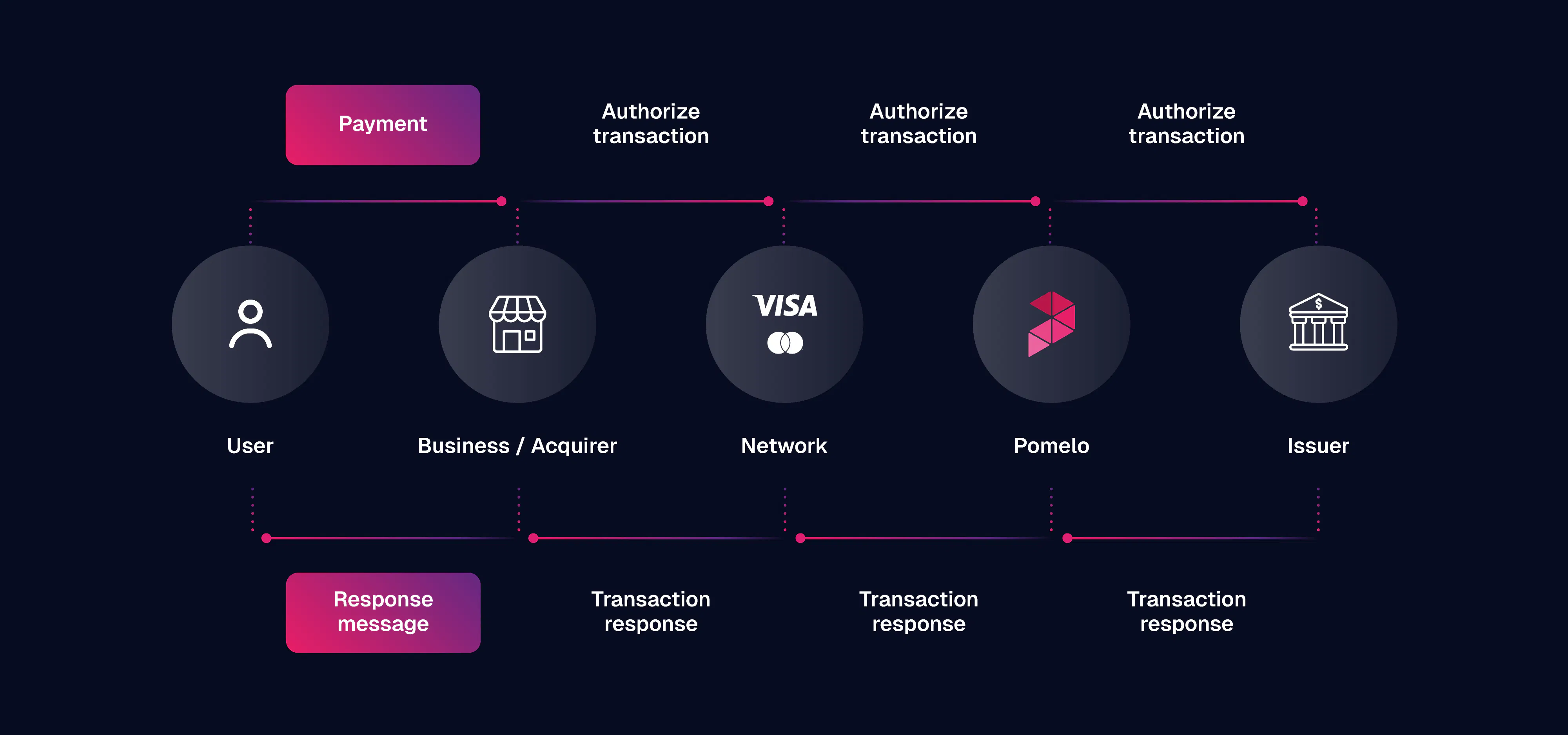
In a very simplified manner, the purchase processing route with cards occurs as follows:
- A customer provides the card data by passing them to the payment machine/gateway of an establishment;
- The payment information then goes to the brand and from there to the processor. It evaluates whether there is sufficient balance for the purchase with the bank/institution that issued the card and performs risk and fraud evaluations, and then communicates everything to the issuer and the brand;
- With the information authenticated in the processing part, the card issuer verifies the necessary card details and informs the processor whether the transaction was authorized or declined;
- Then, the processor passes the decision to the brand and the acquirer (machine or gateway). In case of rejection, the reason must be specified so that the payment terminal can provide the information to the customer.
Check out the example of a purchase flow with Pomelo's processing infrastructure, explained in detail on our documentation site:
But why is the card processor so important?
Let's consider this: have you ever imagined the amount of losses that can occur if card transactions are wrongly authorized or declined? Whether due to fraud or a purchase that someone wanted to make but was unjustifiably declined, leading to the issuing bank blocking the card?
The work of the processor may seem like a technical topic that doesn't concern a card user much, for example. But for those who work with cards, whether in businesses, the acquiring sector, or in issuance, a good processor makes a big (and silent) difference.
The processor is the one that optimizes a super complex financial process.
Although a card transaction is full of intermediaries and networks, and subject to various regulations and numerous security risks, processors ensure that the path becomes quick in just seconds. Any end customer doesn't even need to know what's behind the processing when making a purchase: swipe the card, wait a few seconds, and done! Everything is securely recorded and authorized.
Or even in cases of fraud and cloning, there's the processor again, each time a purchase is declined because something out of the ordinary was detected, preventing harm to the process by alerting the networks and the issuing bank to take appropriate measures.
And currently, the most modern processors are already working with solutions dedicated to simplifying the conversion of cryptocurrencies into fiat currency exchanges, connecting crypto to everyday finances.
It is essential to have a good processing solution for your cards.
Whether it is a company adopting banking as a service solutions or offering cards, having a good processor makes a difference. While large banks already have solutions (which continue to digitize), fintechs and other companies demanding processing services are already operating directly with partners that use APIs, making this path faster and safer by simplifying integration into their businesses.
Among the main points worth considering when adopting processing services, it is crucial to choose who:
- Already has experience and is well-rated in the market;
- Features a rapid transaction processing flow;
- Operates with a solid infrastructure, preferably using APIs to accelerate integration;
- Works transparently with fees and costs;
- Provides good and fast customer service and customer experience;
- And, if you operate with crypto cards, don't forget to choose one that offers hassle-free conversion of your clients' cryptocurrencies to fiat currencies.
No matter what your business purpose is: if you want the cards offered to your clients and users to work efficiently, it's essential to opt for a good processor!