Diego Burgos
Pomelo CTO


Digital and cloud-native technology is here to stay, and financial institutions, banks, and industries in general have begun an adaptation process that marks a before and after in their card operations: some have leapt to the forefront of the market, others have retained their traditional processors, and others are seeking alternatives to update themselves according to their capabilities.
Embedded finance technology allows any entity to incorporate a state-of-the-art card processor, among thousands of other services, to stay updated and relevant in the market and to its users. How is this possible? Thanks to financial technology infrastructure companies, like Pomelo, designed to be modular, scalable, resilient, secure, and easily integrated via APIs, among other key features.
Discover what a financial services technology infrastructure must have to be at the forefront of the market and offer your users a unique experience.
For a bank or financial services company to incorporate state-of-the-art technology to launch and process cards—whether debit, credit, or prepaid—it is key to find the ideal technology partner. This partner should have the know-how and industry experience to ensure that your business is in the hands of specialists capable of advising and supporting your growth. Furthermore, it is critical that they offer a cloud-native infrastructure that simplifies operations, is scalable, and does not depend on data centers and physical servers from previous generations.
 Modularity: the infrastructure must be modular, meaning its components should be independent and combinable to create a variety of solutions. This will allow the solution to easily adapt to the specific needs of your business.Flexibility: quickly adapting to changes in the market and the needs of companies that have integrated this infrastructure is key. This will allow modification and addition of new business units or rules without major complications, such as without needing to seek third parties. Thus, you can respond quickly and stay ahead of the competition.Integrability: this point is crucial, as not all companies have the internal capacity to develop complex technology and modernize at the market's pace. Therefore, having an infrastructure designed to incorporate products or services without friction and through APIs is a true advantage.Scalability and Availability: the infrastructure must be able to handle large volumes of data and transactions. This is essential for companies experiencing rapid growth and needing to scale quickly, while maintaining high levels of availability, reflected in rigorous SLAs and SLOs. A robust infrastructure not only supports growth but also ensures an uninterrupted user experience, even in markets with high demand and under high load conditions. The implementation of multi-regional and redundant architectures ensures that services remain operational and accessible, minimizing the risk of interruptions and allowing you to offer a superior customer experience.Automation: the infrastructure must enable the automation of tasks without human intervention. This will help reduce operational costs, improve efficiency, and optimize data-driven decision-making.Security: the infrastructure must be protected against unauthorized access, data loss, and potential fraud. Additionally, card businesses must have PCI-DSS 4.0 certification, which is mandatory to operate in this market. This is essential for handling customers' confidential information and ensuring data integrity and confidentiality.One-stop shop solution: being able to launch and process your own cards with external infrastructure is fantastic, but imagine it could also address fraud prevention, enable different security features, or offer innovative solutions like card tokenization and 3D Secure. Such a comprehensive solution will save you from developing in-house solutions or needing to incorporate more partners. It's a true win-win!Artificial intelligence: incorporating infrastructure capable of learning from data and making decisions is the latest in technology. Imagine having a complex recommendation system that compiles and analyzes relevant information to improve the accuracy and efficiency of your operations, in addition to helping you understand more about your users' behavior.
Companies that invest in a financial services technology infrastructure that can be integrated through embedded finance and meets these requirements will have everything needed to take their business to the next level!
We are an experienced team in the fintech industry, committed to creating a backend infrastructure that our clients can trust. Our infrastructure is designed to support large volumes of traffic across Latin America. With a single integration, our clients can reach major markets such as Argentina, Brazil, Chile, Colombia, Mexico, and Peru. This vision aims to simplify the adoption of financial services and facilitates easy, agile, and scalable integration.
We developed our 100% cloud-native infrastructure, designed to be resilient, scalable, and secure, complying with the highest industry standards:
PCI DSS v4.0 Level 1 Compliance: We are one of the first Latin American players to reach this level of compliance, ensuring maximum protection for sensitive data.ISO 27001 Certification: We ensure that our systems and processes meet the strictest international information security management standards.The 6 pillars of the AWS Well-Architected Framework: We rigorously follow these principles to guarantee a solid, efficient, and future-ready architecture.Being 100% Cloud Native on AWS means our platform operates entirely in the cloud, taking full advantage of the benefits it offers: speed, resilience, security, and robustness. This not only provides flexibility and scalability as the business grows but also enables autoscaling, self-recovery, and an API-driven operation.
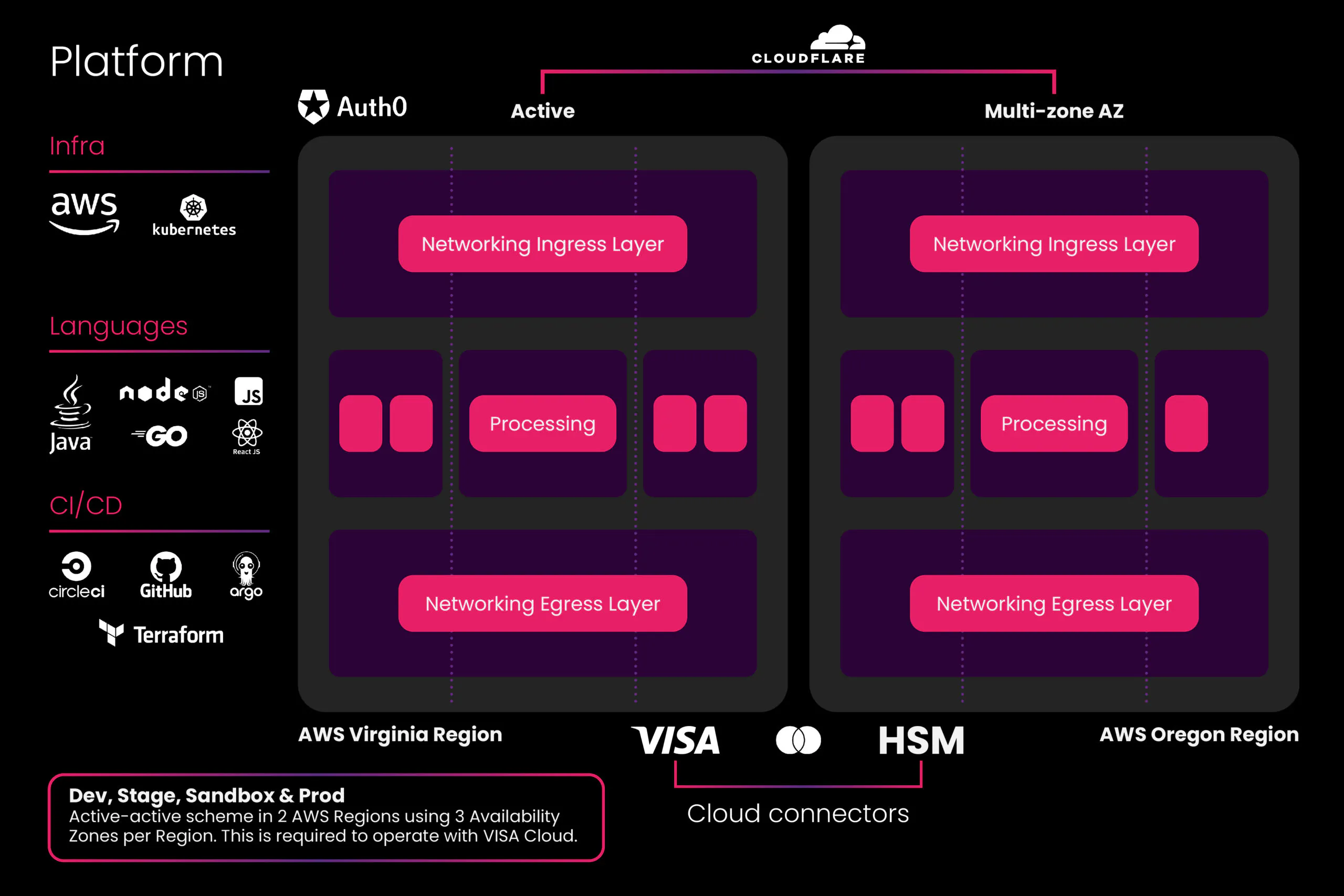
The main productive flows of our infrastructure are configured in an active-active architecture in two AWS cloud regions (Virginia and Oregon), in a multi-account scheme, with a minimum of three availability zones in each and in several environments. Additionally, we have development, staging, and Sandbox environments.
Unlike a more traditional infrastructure, which operates under the premise of a single active production Datacenter with an offline backup system, Pomelo operates in more than 6 data centers simultaneously thanks to its multi-region system. This allows us to have an elastic, scalable, and cyber-resilient infrastructure.
Our work framework allows for the continuous delivery of code using CI/CD under the GitOps methodology, using AWS ECR as an artifact repository and argoCD to deploy products. This ensures quality and maintains the speed that characterizes the company, which allowed us to launch the card issuance and payment processing solution in just 8 months, approved by Mastercard and subsequently by Visa. Both solutions are 100% cloud-based, a milestone recognized by both brands as success stories.
All computing flows operate under a microservices architecture backed by Kubernetes on AWS EKS. This architecture allows Pomelo to achieve an availability of at least 99.995%.
To ensure this availability, we conduct stress tests and chaos engineering on multiregional Kubernetes clusters based on EKS, with full-stack observability across the infrastructure. Thanks to this, we can demonstrate a processing capacity of more than 620 TPS (transactions per second), which means more than 55 million transactions per day! Each transaction internally generates between 6 and 15 microservices requests, depending on the flows.
Record integrations: a constant goal at Pomelo is to achieve rapid integrations that respond to what each client needs. Our current record is only 7 days from the first meeting with the client to the first transaction made with the card powered by Pomelo.Data security: our solution requires a PCI-compliant architecture to implement a secure data lake, capable of handling thousands of transactions per hour. This is protected with encryption in transit and at rest, and a permissions system that allows our clients to access information without compromising data security. For this, we use Amazon S3 for storage, leveraging all included security features to protect their financial data.Regional solution: with a presence in 6 Latin American countries, more than 100 banks, unicorns, and companies from all kinds of industries are already using our solutions to offer all types of cards and for a wide variety of use cases such as corporate solutions, crypto businesses, and many more industries!360º support for our clients: we comply with all regulatory requirements by extracting real-time data from our platform, reducing clients' operational efforts. Additionally, we support them with the generation of regulatory reports and financial reconciliation.Having a modern technological infrastructure is essential for the success of any card business in today’s digital age. A modern technological infrastructure allows transactions to be processed more quickly, offers a more convenient shopping experience, quickly adapts to market changes, scales operations rapidly, and ensures a high degree of protection for customer data.

Talk to our team and get started faster.