The world of payment methods is certainly vast and continues to gain more options. However, some undoubtedly remain the most chosen – and, indeed, topping the list are credit cards. According to a BoaCompra study by PagSeguro, credit cards are the most used payment method in Latin America, accounting for 46% of purchases made in 2021.
This is a payment method that is part of people's lives and increasingly extends its prominence. And why? Simple: currently, not only traditional banks issue cards to their customers, but more and more companies in different sectors choose to offer cards or financial services through solutions like embedded finance. This not only makes them more accessible to people, but also allows more benefits to be offered and creates differentiators that attract more customers.
In addition to being interesting for the end consumer, credit cards are also advantageous for the companies that offer them, not only because they reach new consumers but also because of their business model: there are commissions and fees that are part of each transaction, so all the entities involved get their share.
In this article, learn about the business model of credit cards – the parties involved and the role of each, the entire process from card issuance to payment completion, and all the sources of income that credit cards offer. Here we go!
What is the business model of credit cards?
The credit card is a tool that allows consumers to defer payment for purchases made. Even without having the money to make a transaction, a credit limit is set – defined by the institution offering the card – so that each user can make transactions and later pay them through the statement received at the end of that period, usually monthly.
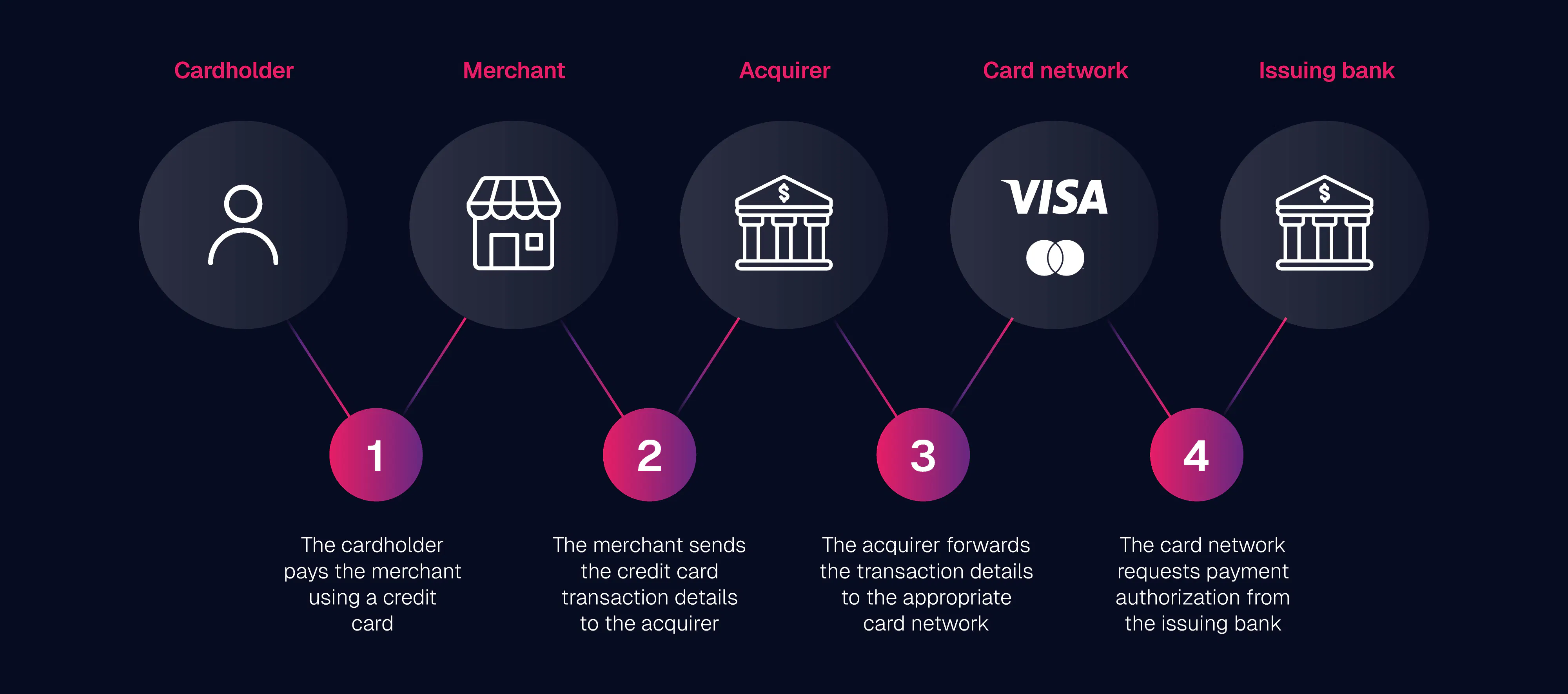
There is an entire flow from the issuance of the card to the payments made with it, involving different parties, each responsible for something. We can call this set of parties “card networks” and it is composed as follows:
 The cardholder: This is the term commonly used for individuals who have a credit or debit card in their name.
- Merchants: These are the establishments that carry out transactions to charge for goods or services acquired by the cardholder. They are responsible for sending the details of all transactions to the acquiring bank.
- The acquirer: This is the financial institution that processes and accepts, online or offline, card payments on behalf of merchants. It has the authorization from banks or networks like Visa or Mastercard to manage this process.
- The Payment Service Provider (PSP): This is the digital tool that links users throughout the entire transaction process on a website from initiation to acceptance or rejection. Its function is to accept card payments and process them securely and easily for the user. In some cases, they offer both acquiring services and payment gateways.
- Credit card networks: These are the entities that authorize, process, and establish the terms of card transactions. They also transfer payments between the issuing bank and the merchant that received the transaction. The most well-known networks are Visa, Mastercard, and American Express.
- The issuing bank: It is the entity that provides credit cards for cardholders to use. Therefore, they represent the link between them and the card network. Also, by issuing cards to users, they commit to the payment account value assumed by the cardholder.
Too much information? Here we have a summarized version so you can see it more graphically!
And what are the commissions or revenues generated by this process?
Being a product that operates on card networks, it generates the following list of revenues (here, we focus on the revenues for the issuer and processor):
- Service fees: They vary depending on the entity, the type of card, and current promotions. They can include charges for issuance, renewal, reprinting of the card, additional printings, or account maintenance. These are defined by the card issuing bank and may not necessarily be charged.
- Refinancing of purchases: consists of modifying the original credit conditions. For example, converting the statement into installments by deferring the total payment again with more interest according to payment plans proposed by the card network. This is frequently used in Argentina, Mexico, and in Brazil it is known as “parcelamento.”
- Revolving: When the cardholder makes a payment on the account statement that is between the minimum payment and below the total payment, resulting in a refinancing of the unpaid amounts. This is one of the most important sources of income for the card issuer!
- Late fees: refer to all charges related to late payments or payments less than the total amount:
- Penalty interest: These are the interests that accrue daily on the unpaid debt after the card has expired. In addition to the applicable fees, this is one of the most significant sources of profit!
- Interchange fee: We explain it in more detail below!
What is the interchange fee?
These are the fees that credit or debit card issuing banks charge merchants for each transaction made with the card. In other words, when processing transactions, the acquiring bank transfers to the merchant, deducting the interchange fee from the transaction amount. This occurs for each transaction.
The interchange fee can vary based on different factors, and here are some:
- the type or industry of the merchant (a hotel chain is not the same as a restaurant);
- the type of card (debit or credit);
- whether the card is individual or corporate (corporate rates are usually higher);
- whether the transaction was made digitally or in person (online purchases carry higher fees than those made at physical locations);
- specific arrangements of large merchants with high transaction volumes (more transactions, lower rate).
It is generally 1.5%, but can vary based on these factors. Learn all the details about the interchange fee of the Visa and Mastercard card networks.
In Argentina, the Central Bank established a maximum cap on interchange fees in 2017 to encourage the emergence of new entrants into the acquiring market. That is, to ensure more businesses choose to accept these payment methods, they set a maximum cap on the interchange fee that can be charged for each transaction made.
The fee percentage has been gradually reduced each year since the regulation, currently reaching 0.60% for debit cards and a maximum of 1.30% for credit cards. However, in 2017 it was as high as 2%.
And why can it be an interesting source of income? Simple: one must consider the number of customers who hold the card and the transaction volume generated by each user, in addition to the value of each transaction.
And in Latin America, what is the situation with credit cards?
The credit card in Latin America is a widely used product. According to a 2018 Statista study, 67.2% of people with credit cards in Argentina used them for long-term payments, while in Brazil it was 81.6%. Undoubtedly, they play a major role in the region!
Due to the large amount of the population underserved by the banking system and the lack of financing, there is a great opportunity for credit products from non-traditional financial entities. These can appear as an additional activity to the core business of companies, regardless of what that may be.
How can companies take advantage of the benefits of massive card use?
Credit cards are products that have not evolved much over the years in the traditional system. Therefore, considering implementing them as a business unit has the advantage that there will be rapid user adoption if you offer differentiators that address their needs. In that case, they will be easily accepted, and frequent use will face fewer barriers compared to trying a 100% unknown product.
The opportunity for new companies will be to provide a better experience for their users beyond the purchase action that we all know and understand: adding features, managing expiration dates or limits, creating temporary cards for specific purchases, financial education, and visibility of how they are spending their money, among many others!
For all that we presented above, it is a great opportunity to innovate and add benefits to a product that we all know and use.