Agentic payments are already a reality in the payments ecosystem. These are autonomous, intelligent payments made without direct human intervention, powered by artificial intelligence. And they promise to transform the way people interact with money and merchants.
The rise of agentic payments lines up with a demand that's already clear in the market: users want financial experiences to be increasingly automatic, instant, and secure. It's no longer just about paying without touching a card, it's about not having to think about paying at all. Technologies like tokenization, artificial intelligence, and digital wallets are what make it possible for purchases to execute themselves.
Let's look at how agentic payments work, how artificial intelligence drives their development, some real-world use cases, and how to get your business ready to adopt them.
Agentic payments: what they are and how they work
Agentic payments are payments carried out by intelligent agents, such as virtual assistants, apps, or devices, without active user involvement in each transaction. In other words, they happen automatically, but according to rules the user set in advance.
This innovation is a logical evolution of the financial ecosystem. As more devices gain intelligence, more everyday tasks get automated, including the act of paying. Major companies have already taken notice:
Google launched AP2, an open protocol for enabling agentic payments: it's designed to allow secure payments made by AI agents on users' behalf. Built together with companies like Mastercard, PayPal, Coinbase, and Salesforce, AP2 sets up a unified framework compatible with all types of payments, including cards, bank transfers, and crypto assets.
In addition, OpenAI launched "Buy it in ChatGPT", an instant purchase feature built right into the chat that, through the Agentic Commerce Protocol co-developed with Stripe, lets users and AI agents complete orders without ever leaving the conversation, giving merchants and developers a fast, secure way to adopt "Instant Checkout" directly from ChatGPT.
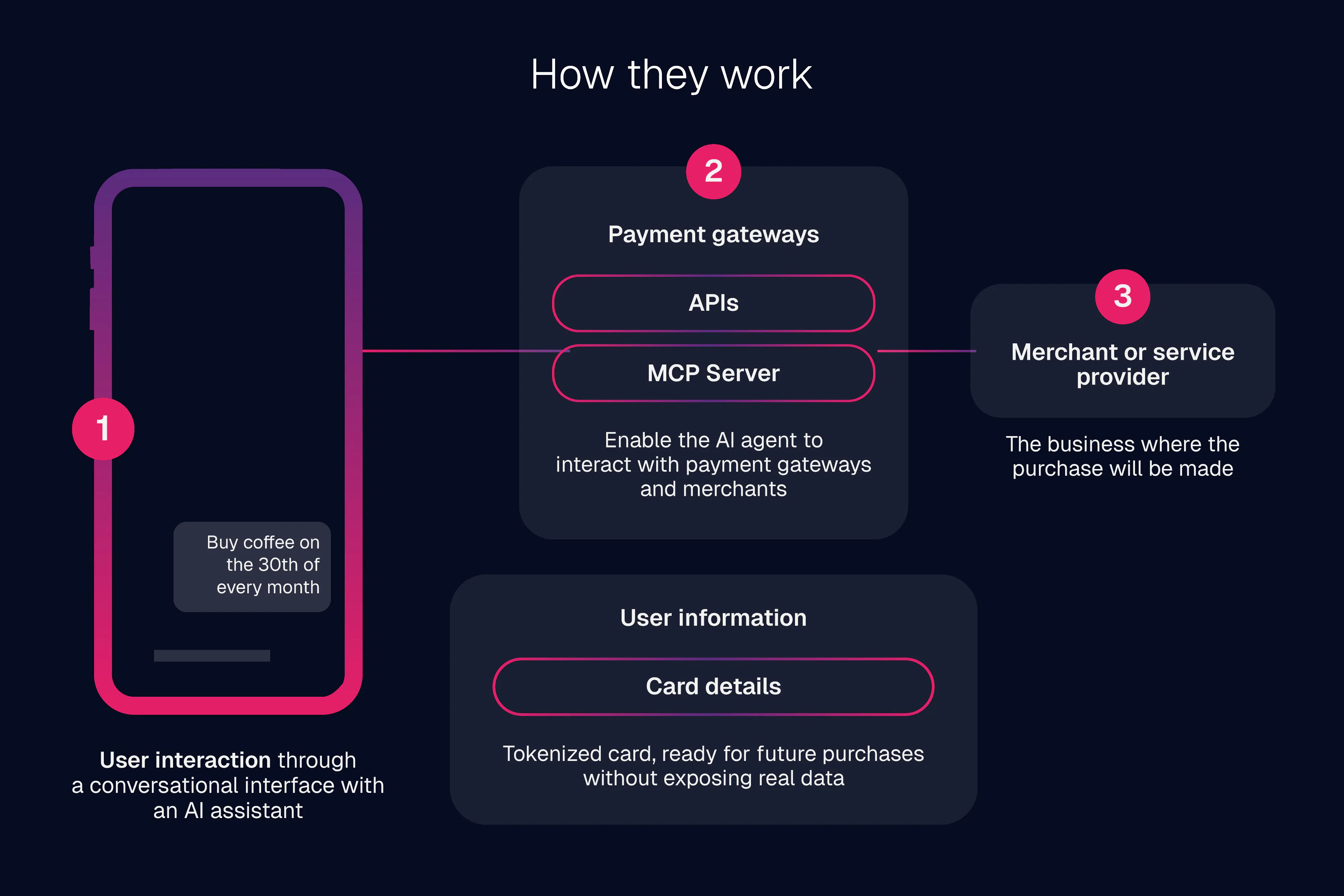
Behind the simplicity of an agentic payment sits a technical machine that combines conversational interfaces, tokenization, and payment gateways. Here are the main steps in how it works from a technical standpoint:
 User interaction: it all starts with a direct instruction inside a conversational interface (for example, an AI assistant like ChatGPT, Copilot, or Claude). The user never leaves that interface: they can ask the agent to find a service, set a budget, and complete the purchase.
- Payment gateways: the agent connects to the payment gateway through APIs and secure protocols (such as MCP). This is where the "translation" happens between the user's instruction and the actual transaction.
- Merchant or service provider: the transaction reaches the merchant or service the user wants to buy from. For the business, there's no difference from a traditional digital purchase; it receives the payment as usual.
- User information: sensitive details, like card or personal data, are tokenized beforehand and stored securely at the gateway. In other words, the card is loaded through tokenization and ready to use for future purchases, without ever exposing the real data.
The key point: agents can interact directly with gateways and third parties thanks to standardized APIs. That means a virtual assistant can search for, choose, and pay for services without the user ever having to leave the conversation or re-enter their information.
Use cases for agentic payments
There are many real-world examples of agentic payments that help simplify everyday life for users:
- Predictive e-commerce: a marketplace detects, through purchase and consumption history, that a user tends to order pet food every 30 days. The agent schedules the purchase in advance, locking in stock and a better price.
- Family remittance payments: a user in the U.S. sets up an agent that converts USD to MXN every month and automatically sends money to their family. The agent looks for the best exchange rate before executing the transfer.
- Personal loan payments: a lending app sets up agents to automatically collect installments on the due date. The agent notifies the user 24 hours ahead and settles the payment as long as there's available balance.
- Public transit payments: a user loads their transit card into their digital wallet. The agent sets up an automatic top-up every time the balance drops below $200 ARS.
- SaaS subscriptions for SMBs: a small business sets up its treasury agent to pay for software licenses (e.g., accounting or CRM tools) within a monthly budget. If the price goes up, the agent evaluates alternatives and may recommend switching providers before renewal.
- Picture a digital bank in Mexico that builds agentic payments into its app. A customer sets up automatic monthly payments for basic utilities (electricity, water, and internet), as long as their account balance stays above a certain threshold:
- The intelligent agent reviews the electronic bills, confirms the amounts match what's expected, and executes the payment without the user having to step in.
- The customer just gets a confirmation notification: "Your $600 MXN internet bill has been paid successfully."
These kinds of experiences don't just add convenience, they also help drive banking adoption and loyalty in a market where utility payments are still often handled at a teller window or in cash.
Mastercard, for its part, has already announced new tools built specifically to enable agentic payments. The company launched its "Mastercard Commerce Intelligence" alongside a series of strategic partnerships aimed at creating automated, secure, and frictionless shopping experiences.
Why does this matter for fintechs and issuers?
At Pomelo, we see this as an opportunity for issuers, banks, and fintechs to offer smoother experiences that fit users' increasingly digital lifestyles. It's also an innovation that speeds up the adoption of artificial intelligence and tokenization, tools that strengthen and reinforce the security of digital payments.
Here are a few keys to getting ready for this new era of payments:
- Secure tokenization: stores card data and authorizes automatic payments without exposing sensitive information. It also enables NFC payments: a double benefit.
- Smart authorizer: essential for approving or declining payments in real time, applying rules the user has defined (amount, frequency, merchant, etc.).
- Wallet compatibility: integrating cards with Apple Pay or Google Pay is the foundation that lets devices act as buyers.
- Open, API-first architecture: makes it easy to plug new agents (apps, assistants, IoT devices) into the payments ecosystem.
Legal challenges and opportunities to strengthen the technology
As with any innovation, there are regulatory and technological considerations, and above all, risks to weigh. A comprehensive view is what allows a solution to scale without setbacks. Here are a few challenges worth considering when adopting agentic payments:
- Operational scalability: autonomy will generate more transactions in less time. That calls for robust monitoring systems and the capacity to handle high transaction volumes without sacrificing security or experience.
- Data protection and transparency: agents handle large volumes of encrypted personal and financial data. Companies need to back that up with cybersecurity strategies and robust technology to keep data safe and reduce the risk of breaches.
- Strong authentication and consent: transactions are no longer initiated by humans, so it's essential to review how they fit with data protection regulations and set clear rules: is there a cancellation window? When can the user step in?
The future of payments is invisible, automatic, and secure
At Pomelo, we believe that behind every simple payment experience there's powerful, flexible, and secure infrastructure. And this new paradigm confirms it: for payments to become automatic, fast, and tech-driven, the infrastructure behind them has to be next-generation.